Reading time: a rare solar eclipse
Rare 'ring of fire' annular solar eclipse to cast shadow over Africa and Asia
Event will be visible across a narrow band from Congo-Brazzaville to southern China
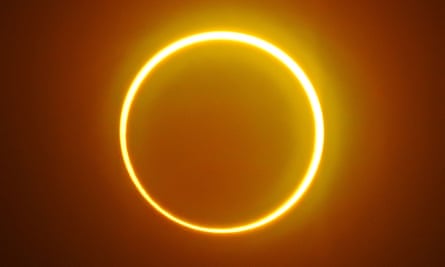
Skywatchers
along a narrow band from west Africa to the Arabian peninsula, India
and southern China will witness the most dramatic “ring of fire” solar
eclipse in years on Sunday.
Annular eclipses
occur when the moon passes between Earth and the sun, but not quite
close enough to our planet to completely obscure the sun’s light.
They occur every year or two, and can only been seen from a narrow pathway across the planet.
Sunday’s
eclipse coincide’s with the northern hemisphere’s longest day of the
year, the summer solstice, when Earth’s north pole is tilted most
directly toward the sun.
The eclipse will be
seen first just a few minutes after sunrise in north-eastern
Congo-Brazzaville. This is the point of maximum duration, with the
blackout lasting 1 minute and 22 seconds.
It
will reach “maximum eclipse”, with a perfect solar halo around the moon,
over Uttarakhand near India’s border with China just after midday. The
exact alignment will only last for 38 seconds.
“The
annular eclipse is visible from about 2% of the Earth’s surface,”
Florent Delefie, an astronomer and the Paris Observatory, said. “It’s a
bit like switching from a 500-watt to a 30-watt light bulb.”
People
hundreds of kilometres on either side of the centreline across 14
countries will also see light drain from the day, but not the “ring of
fire”.
“Good weather is the key to successful
eclipse viewing,” the astrophysicist Fred Espenak writes on the Nasa
Eclipse website. “Better to see a shorter eclipse from clear sky than a
longer eclipse under clouds.”
There will be a
second solar eclipse in 2020 over South America on 14 December, but
because the moon will be a bit closer to Earth it will block on the
sun’s light entirely. It will take less than 100 minutes to move across
the continent.
Even if the day has darkened,
looking at a solar eclipse with the naked eye is dangerous. Sunglasses,
which do not filter out ultraviolet rays, do not offer any protection,
Delefie said. “The sun is so bright that even when there’s only a tiny
portion visible, it is still dangerous for the eyes,” he said.
adapted from the Guardian
Commentaires
Enregistrer un commentaire