T 4 8 9 an article from sciencenews
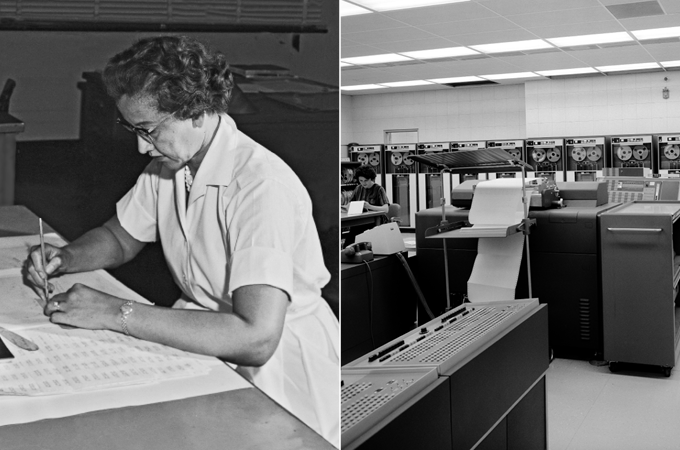
A) Explain the reference to 1962 and the book Hidden Figures.
B) Explain the main idea of the article. Use your own words.
To live up to the hype, quantum computers must repair their error problems
The devices will reach their potential only if they can fix their glitches
Astronaut John Glenn was wary about trusting a computer.
It was 1962 early in the computer age, and a room-sized machine had calculated the flight path for his upcoming orbit of Earth — the first for an American. But Glenn wasn’t willing to entrust his life to a newfangled machine that might make a mistake.
The astronaut requested that mathematician Katherine Johnson double-check the computer’s numbers, as recounted in the book Hidden Figures. “If she says they’re good,” Glenn reportedly said, “then I’m ready to go.” Johnson determined that the computer, an IBM 7090, was correct, and Glenn's votage became a celebrated milestone of spaceflight.
A computer that is even slightly error-prone can doom a calculation. Imagine a computer with 99 percent accuracy. Most of the time the computer tells you 1+1=2. But once every 100 calculations, it flubs: 1+1=3. Now, multiply that error rate by the billions or trillions of calculations per second possible in a typical modern computer. For complex computations, a small probability for error can quickly generate a nonsense answer. If NASA had been relying on a computer that glitchy, Glenn would have been right to be anxious.
Current versions are relatively wimpy, but with improvements, quantum computers have the potential to search enormous databases at lightning speed, or quickly factor huge numbers that would take a normal computer longer than the age of the universe. The machines could calculate the properties of intricate molecules or unlock the secrets of complicated chemical reactions. That kind of power could speed up the discovery of lifesaving drugs or help slash energy requirements for intensive industrial processes such as fertilizer production.
But there’s a catch: Unlike today’s reliable conventional computers, quantum computers must grapple with major error woes. And the quantum calculations scientists envision are complex enough to be impossible to redo by hand, as Johnson did for Glenn’s ambitious flight.
If errors aren’t brought under control, scientists’ high hopes for quantum computers could come crashing down to Earth.
Fragile qubits
Conventional computers — which physicists call classical computers to distinguish them from the quantum variety — are resistant to errors. In a classical hard drive, for example, the data are stored in bits, 0s or 1s that are represented by magnetized regions consisting of many atoms. That large group of atoms offers a built-in redundancy that makes classical bits resilient. Jostling one of the bit’s atoms won’t change the overall magnetization of the bit and its corresponding value of 0 or 1.But quantum bits — or qubits — are inherently fragile. They are made from sensitive substances such as individual atoms, electrons trapped within tiny chunks of silicon called quantum dots, or small bits of superconducting material, which conducts electricity without resistance. Errors can creep in as qubits interact with their environment, potentially including electromagnetic fields, heat or stray atoms or molecules. If a single atom that represents a qubit gets jostled, the information the qubit was storing is lost.
Before quantum computers can reach their much-hyped potential, scientists will need to master new tactics for fixing errors, an area of research called quantum error correction. The idea behind many of these schemes is to combine multiple error-prone qubits to form one more reliable qubit. The technique battles what seems to be a natural tendency of the universe — quantum things eventually lose their quantumness through interactions with their surroundings, a relentless process known as decoherence.
“It’s like fighting erosion,” says Ken Brown, a quantum engineer at Duke University. But quantum error correction provides a way to control the seemingly uncontrollable...
Commentaires
Enregistrer un commentaire